If the images doesn't load correctly, please click here to see the online version.
Chinese Culture: Tea Culture
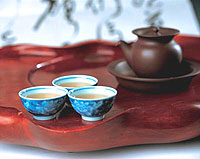 Tea culture is an important part of Chinese tradition. Alongside social development and progress, tea has not only played a role in driving the development of the economy, but has also remained a feature of people's lives. Moreover, tea drinking has gradually developed into a resplendent tea culture and become a bright pearl in the social life of Chinese civilization.
The practice of tea culture can bring the spirit and wisdom of human beings to a higher orbit. Tea has an extremely close relationship to Chinese culture, and its study covers a wide field and has very rich content. It not only embodies the spirit of civilization, but also the spirit of ideological form. There can be no doubt that it has been beneficial in enhancing people's social accomplishments and appreciation of art. more...
 The history of Chinese tea is a long and gradual story of refinement. Generations of growers and producers have perfected the Chinese way of manufacturing tea, and its many unique regional variations.
The original idea is credited to the legendary Emperor Shennong, who is said to have lived 5 000 years ago. His far-sighted edicts required, among other things, that all drinking water be boiled as a hygienic precaution. A story goes that, one summer day, while visiting a distant part of his realm, he and the court stopped to rest. In accordance with his ruling, the servants began to boil water for the court to drink. Dried leaves from a nearby bush fell into the boiling water, and a brown substance was infused into the water. As a scientist, the Emperor was interested in the new liquid, drank some, and found it very refreshing. And so, according to legend, tea was created in 2737 BC.
 The main varieties of Chinese tea are classified as green tea, red tea (black tea), Wulong tea, white tea, yellow tea, and reprocessed tea.
Green tea is also called unfermentated tea. It is made with the new shoots of appropriate tea trees as raw materials, by applying the typical techniques of inactivation, rolling and drying. According to the drying and inactivation techniques, it is sub-divided into stir-fried green tea, roasted green tea, sun-dried green tea and steamed green tea. Green tea has the characteristics of "green leaves in a clear soup with a strong astringent taste ". It is the tea category with the longest history (more than three thousand years) and also the one with the largest output in
The West Lake Dragon Well is called Dragon Well for short. The tea of this name is produced in the mountainous regions around Longjing (Dragon Well) Village to the southwest of West Lake in
Red Tea (black tea) Red Tea is also called fermented tea. Only the new shoots of tea leaves are suitable for use as the raw material for making this tea. It is exquisitely made through the typical technical processes of wilting, rolling, fermentation and drying. Its infusion is mainly red in tone. Hence what is known as black tea elsewhere is known as red tea in
Wulong (Oolong) Tea is also called blue tea, and is an unfermented tea. It is a tea category with some unique and distinctive characteristics. Wulong tea, as a blend of green tea and red tea, has qualities of both green tea and red tea. It not only has the thick and fresh flavor of red tea, but also has the pleasant fragrance of green tea. It is affectionately known as green leaves with a red edge. more...
Compressed Tea. These products, which are made by taking teas from the categories above as materials and reprocessing them, is called reprocessed tea. The product range includes scented tea, pressed tea, instant tea, extracted tea, fruit tea, medicinal tea and health tea, which have a variety of flavors and effects. more...
Scented tea is made by mixing and aromatizing tea leaves with scented flowers, letting the tea assimilate the fragrance of the flowers by taking advantage of the absorptivity of tea leaves. The dhool (a collection of tea leaves prior to drying) used for aromatization of a scented tea is mainly roasted green tea and a small amount of slender and tender stir-fried green tea. When processing the scented tea, the dhool and fresh fragrant flowers are piled up layer upon layer so that tea assimilates the fragrance of flowers. When the tea has absorbed the flowers' scent new flowers are added and the process repated. more...
 Chinese tea lore is several hundred years, possibly even thousands of years, older than that of
Tasting tea
The quality of the tea is judged by the color, fragrance and flavor of the tea, the water quality and even the tea set. When tasting tea, the taster should also be able to savor the tea thoroughly. more...


没有评论:
发表评论